

Rewilding: Leading from the Right Side of the Brain
Returning to the Way Our Brains Were Wired to Lead

Rewilding is a series about returning to the wisdom of creation on leadership, formation, and community.
You’ve probably heard “rewilding” as a conservation term. It’s the process of restoring ecosystems to their natural state. We’ll be diving more into this term throughout the series as we learn what the process of rewilding has to teach us about flourishing.
But…have you ever thought about the idea of “rewilding” your brain!?
I bet not…
If we want to return to the way creation was designed to flourish, it also includes the way we were designed to flourish…brains and all.
If you know much about me, you may know that I have become a bit of a neuroscience nerd.
I know. An artist who loves neuroscience!? Fascinating.
So, what is it about brain science that has captured my attention?
It’s what neuroscience research is discovering about the way our brains were designed to learn and lead.

In the last post, I talked about the revelation I had when talking with my friend Ang about the difference between management and leadership.
Management asks: How do we control variables to achieve outcomes?
Leadership asks: How do we create the conditions where life can flourish?
And, it turns out, these two approaches to leadership happen in different systems of the brain.
Psychiatrist and neurotheologian Dr. Jim Wilder, along with spiritual leader Marcus Warner, explore this in their book Rare Leadership: 4 Uncommon Habits for Increasing Trust, Joy, and Engagement in the People You Lead. I am indebted to their research for this article.
Management: The Slow Track
According to Warner and Wilder, the management system of the brain—the part that leads through the efficient accomplishment of tasks—is associated primarily with left-brain functions.
This side of the brain is responsible for strategy, words, analytical thinking, problem-solving, and long-term planning.

It is considered the “slow track” because it functions at the speed of conscious thought.1
According to Warner and Wilder,
The slow-track system operates more slowly, but it is, of course, what we notice consciously. The slow track is optimized for management. Its primary job is to monitor results and provide explanations and solutions to the problems we face. The slow track gets most of the attention in leadership development.2
Often, we mistake management for leadership.
I know I did.
I have been formed by a culture that has tended to measure my worth by my results.
You too?
So when it came to leadership, I assumed leadership simply meant not just doing more myself—but getting others to do more too.
As Wilder and Warner write:
Most people are moved into leadership because they are effective workers. They do more or better work than others. They often do not distinguish improving work productivity from leadership.3
Whole organizations have been shaped with this slow-track system as the dominant form of leadership.
But, how did we come to the perspective that leadership just means being productive?
Maybe it’s the influence of capitalism with its emphasis on efficiency, growth, and measurable outcomes.
Maybe it’s due to the ways we have been shaped by colonial patterns that prize power, control, and domination.
Maybe it’s because of the ways we have been formed by colonialism with its thirst for power and domination.
Maybe its the influence of the Enlightenment, where rational ways of knowing were elevated over embodied and relational wisdom.
Or perhaps it traces back to the Industrial Revolution, when machines increased efficiency and output but also contributed to a growing disconnection from the land, our bodies, and one another.
I’m not sure exactly what got us here, but somewhere along the way, we began to believe that to lead well meant to produce more—rather than to cultivate life.
As I wrote in The Art of Vinemaking,
A productivity-driven culture rewards measurable success with financial gain, increased influence, and upward mobility. These rewards aren’t inherently evil, but when they drive us, we tend to push ourselves, others, and creation toward demands that are ultimately dehumanizing.
Our relationships become transactional at best, and exploitative at worst.
Our character withers, showing up in rotten fruit. We begin to value people based on what they contribute to the bottom line—elevating the wealthy, influential, and powerful, while overlooking the poor, the marginalized, and the oppressed.
When we prioritize outcomes, the ends justify the means.
So the ends of multiplication and growth and “impact” justify the means of exploitation, abuse, and narcissistic leadership.
We’ve seen the fallout of this on full display in the last few years, haven’t we?
Moral failures of influential pastors.
Whole systems churning people up and spitting them out.
This has become a normative experience for faith-based nonprofits and ministries in the West, where people become an expendable resource for the sake of the mission.
But is there a different way?
According to Warner and Wilder, there is.
And it’s a style of leadership associated with a different system in the brain.
Leadership: The Fast Track
The right side of the brain is sometimes described as the brain’s “fast track” because it operates at a supra-conscious speed.
It is highly relational, processing embodied experiences, connection with God and others, identity, motivation, creativity, values, and emotions.

According to Wilder and Warner, the right brain functions as the brain’s “master system”—the more powerful engine of the two and the brain’s primary pathway for processing experience.
In practice, this means we first experience life through the right side of the brain. Our embodied experiences and emotions are processed before the left side of the brain steps in to make meaning through words, analytical thinking, and problem-solving.
It’s the difference between recognizing someone we love when they walk into the room versus rationally explaining how we know them. Before we can put words to it, our bodies already know.
Wilder and Warner suggest this pattern extends beyond individual experience and into leadership itself.
And according to them, when leaders focus on building relational health into their organizations, management systems improve automatically.4
“Focus on building management systems, and leadership is left to chance. Focus on building leadership systems, and you will always improve management. This is automatic.”5
Relationship first. Strategy and outcomes follow.
And, if we give a closer look to the rest of creation, we see this pattern all over the place.
Invest in the soil and you get quality fruit.
Invest in biodiversity and interdependence and you get resilience.
It’s easy to see this when we pay attention to ecological communities, but it’s quite rare in human ones. Yet, I’m seeing glimpses of it here and there that have been changing the way I look at leadership and community.
Cultivating Flourishing
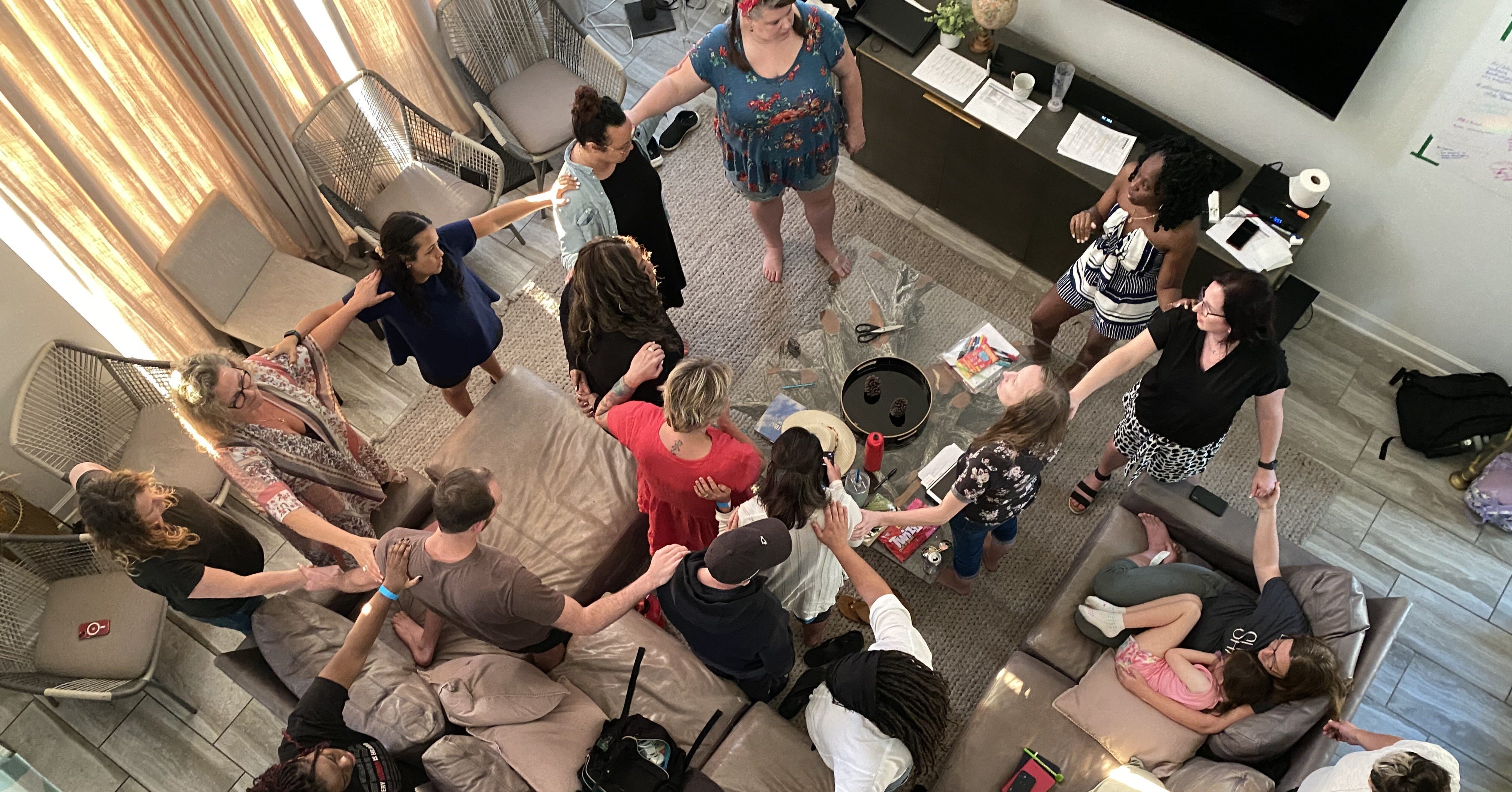
If you’ve been following my work for a while, you’ve probably heard me talk about my Boundless Community—a collective of inspirational misfits I’ve come to belong to.
Founded by Danielle Strickland, this community brings together leaders from diverse initiatives who are pursuing justice, restoration, and flourishing in all kinds of ways.
Each year, we gather for an annual Boundless retreat, which has become one of the most transformative places of belonging in my own life. It’s also one of the clearest places I’ve experienced what flourishing leadership and community can actually look like.
At one of our Boundless Retreats a few years ago, I sat by the pool next to several of our team members. We started talking through roles, responsibilities, and organizational structure of one of our initiatives.
We were trying to answer all the normal leadership questions:
What does the organization need?
Who should do what?
And then one of our team members spoke up about his role in the organization:
“I honestly don’t think I can thrive in this role. I can tell it’s already triggering trauma from my previous church experience.”
What happened next surprised me.
Danielle, one of the founders of Boundless, responded:
“If this organization grew and multiplied and everyone used it through your leadership—but it burned you out—it would all be shit to me. That would literally be the worst thing that could happen.”
I remember sitting there stunned.
I had never heard anyone talk like this before.
She painted a picture of what nearly every nonprofit environment I had known had taught me to pursue: numerical growth, multiplication, impact, scale—wrapped in all the right Christian language.
And then she rejected it.
Not because growth is bad.
But because growth at the expense of the person carrying it is not flourishing.
I had never seen a leader care more about the flourishing of the person than what they produced.
This was simply unheard of. Or was it?
Wasn’t it Jesus who said,
“What good is it for someone to gain the whole world, yet forfeit their soul?
Or what can anyone give in exchange for their soul?” - Mark 8:36-37
Danielle then proceeded to ask,
“What would it delight you to do?”
Not what should you do.
Not what do we need.
But: Where is the Spirit already at work through your design?
In essence, Danielle was asking,
Where is the sap flowing into the vine?
Where are you on the verge of bud break, ready to grow if we could just position you in the right place to receive the sunlight?
What might need to be pruned back so you can focus on healing?
There it was again.
Good leadership is cultivation.
And Danielle had just given me a masterclass in it.
Leading from the Right Side of the Brain
When leaders lead from the right side of the brain, they see communal flourishing as more essential than outcomes.
As a result, communities become:
Less transactional and more relational.
Less extractive and more generative.
Less oppressive and more liberating.
Less life-draining and more life-giving.
They begin to look more like the kingdom of God.
And maybe this is where rewilding begins.
Not by abandoning strategy.
Not by rejecting outcomes.
Not by becoming less intentional.
But by remembering what comes first.
Cultivation before production.
Relationship before efficiency.
Formation before multiplication.
Because flourishing cannot be forced or rushed for the sake of output.
You can manufacture outcomes for a season.
You can squeeze more fruit from exhausted vines.
But eventually the whole thing falls apart.
As Warner and Wilder put it so acutely,
If the master system is untrained or misfiring, the ‘successful’ leader will drive herself and her group toward anxiety, anger, depression, and burnout. In the end, this results-focused leader will produce a structure that is likely to come to a grinding halt or spectacular crash.
As Jesus said, “You will know them by their fruit.” - Matthew 7:14.
So, what kind of fruit do we produce as leaders?
Maybe the question for leaders is not: How do I get more out of people?
But: What conditions am I creating for people to become more fully alive?
Where is trust growing?
Where is delight returning?
Where is joy becoming contagious?
Where is the Spirit already at work?
Because if Jesus is right, that our souls matter than gaining the whole world, then perhaps even well-intended multiplication and influence isn’t really kingdom fruit if the people are chewed up in the process.
Perhaps the greatest measure of leadership isn’t what we build.
It’s whether people become more whole in the process.
Marcus Warner and Jim Wilder, Rare Leadership: 4 Uncommon Habits for Increasing Trust, Joy, and Engagement in the People You Lead (Chicago: Moody Publishers, 2016), 27.
Warner and Wilder, Rare Leadership, 25.
Warner and Wilder, Rare Leadership, 25.
Warner and Wilder, Rare Leadership, 29.
Warner and Wilder, Rare Leadership, 29.